
In-House Video Production vs Hiring a Production Company: How to Make the Right Call
Most marketing and events teams hit this question at some point. You are producing more video than you used to. Someone suggests hiring a full-time videographer. Someone else points out what a production company costs per project. And suddenly you are in a conversation that nobody quite prepared for.
The answer is rarely as clean as either side makes it sound. In-house gives you speed and availability. A production company gives you capability and scale. And for most organizations, the right setup is not one or the other.
At Argus HD, we have worked alongside in-house video teams at companies like Google, Salesforce, and Microsoft, and we have also been the entire production operation for organizations with no internal capability at all. This guide is our honest take on when each model makes sense, what each one actually costs, and where the decision gets more complicated than a simple cost comparison.
The Question Usually Comes Up at a Specific Moment
Nobody asks this question in the abstract. It comes up when something changes. Maybe the one person handling video is at capacity. Maybe the content coming out of the current setup is not good enough anymore. Maybe leadership approved a campaign that is bigger than anything the existing setup can handle.
A common scenario we see: a company hires one videographer to cover social clips and internal updates. It works fine for a year. Then they plan an all-hands meeting for 800 people, or a product launch that is going to be livestreamed to 10,000 viewers. That same one person is now expected to direct, run cameras, manage audio, handle the stream, and deliver edited content the next morning.
That is not a video production problem. That is a scope problem. And it is usually the moment the in-house versus outsource question stops being theoretical and becomes urgent.
What an In-House Video Team Actually Costs
The salary is only the starting point. A single videographer in the San Francisco Bay Area runs between $75,000 and $110,000 a year once you factor in benefits, payroll taxes, and the Bay Area cost premium. A more complete team with dedicated shooting, editing, and creative direction capability requires two or three people, which means the annual personnel cost alone can approach $250,000 before equipment and overhead are counted.
The Hidden Costs That Do Not Show Up on the Hire Requisition
- Camera bodies, lenses, audio gear, and lighting: a professional field kit costs $25,000 to $60,000 to build from scratch
- Editing software, storage infrastructure, and cloud backup: $5,000 to $15,000 per year depending on output volume
- A dedicated filming space if your office does not have one built in
- Recruiting costs when someone leaves, plus the three to six months it takes a new hire to learn your brand voice, your executives, and your internal workflows
- Management time: someone senior is always reviewing and directing the work, and that time has a cost even when it does not show up on a vendor invoice
The cost only pencils out when there is enough consistent volume to keep the team busy. A company producing two polished videos per month has a very different calculation than one that needs one executive keynote per quarter and a product launch video twice a year.
There is also a risk the spreadsheet misses entirely: single-person dependency. When one individual holds your entire video capability, your brand’s visual identity, your editing templates, your institutional knowledge about how leadership likes to be filmed, all of that walks out the door if they quit. We have seen this derail event production timelines when an in-house hire left two weeks before a major corporate AV event was scheduled.
What Hiring a Production Company Costs
A production company charges per project or on retainer. The per-project model means you pay for scope, not for availability. A focused executive interview or panel session runs $5,000 to $12,000. A multi-camera event production with a full crew runs $15,000 to $40,000 depending on scale and complexity. A branded campaign or product launch film runs higher.
That fee covers more than a shoot day. You are paying for a director, camera operators, audio engineers, editors, a producer managing the logistics, and specialized post-production roles like a colorist or motion designer that most in-house setups do not have on staff. Revisions, final deliverables, and export in multiple formats are typically included in the quote.
Per project, this looks more expensive than an in-house hire. Where it earns that cost back is in the gap between what you need and when you need it. If your video production needs are event-driven, campaign-based, or seasonal, paying a full crew for the three weeks you actually need them is significantly cheaper than keeping that crew on payroll for the forty-nine weeks you do not.
The Capability Gap Nobody Talks About
Cost is the first thing people compare. Capability is what actually determines whether the finished product does its job.
An in-house team does certain things better than an outside company. Quick turnaround on simple content. Brand familiarity. Access to executives for fast-turnaround internal communications. The ability to capture something spontaneous without scheduling a crew.
A production company does other things better. And for large-scale or technically complex work, the gap is not a matter of preference. It is structural.
What a Professional Production Company Brings That an In-House Team Rarely Can
- A multi-camera live event production with a technical director calling live cuts, dedicated camera operators, and a broadcast engineer monitoring the outgoing stream requires a team of six to twelve people with specialized equipment. An in-house team of two cannot replicate that.
- A hybrid event serving both an in-room audience and a global virtual audience simultaneously requires parallel technical operations. The people managing the room and the people managing the stream are doing different jobs that cannot be combined into one role.
- Color grading, sound design, and professional post-production on a brand film or a launch video require dedicated specialists most in-house setups do not have on staff
- Redundancy. A professional crew brings backup cameras, backup audio feeds, backup encoding hardware. When a camera fails during a keynote, the production continues. When an in-house setup loses its only camera, the event is not recoverable.
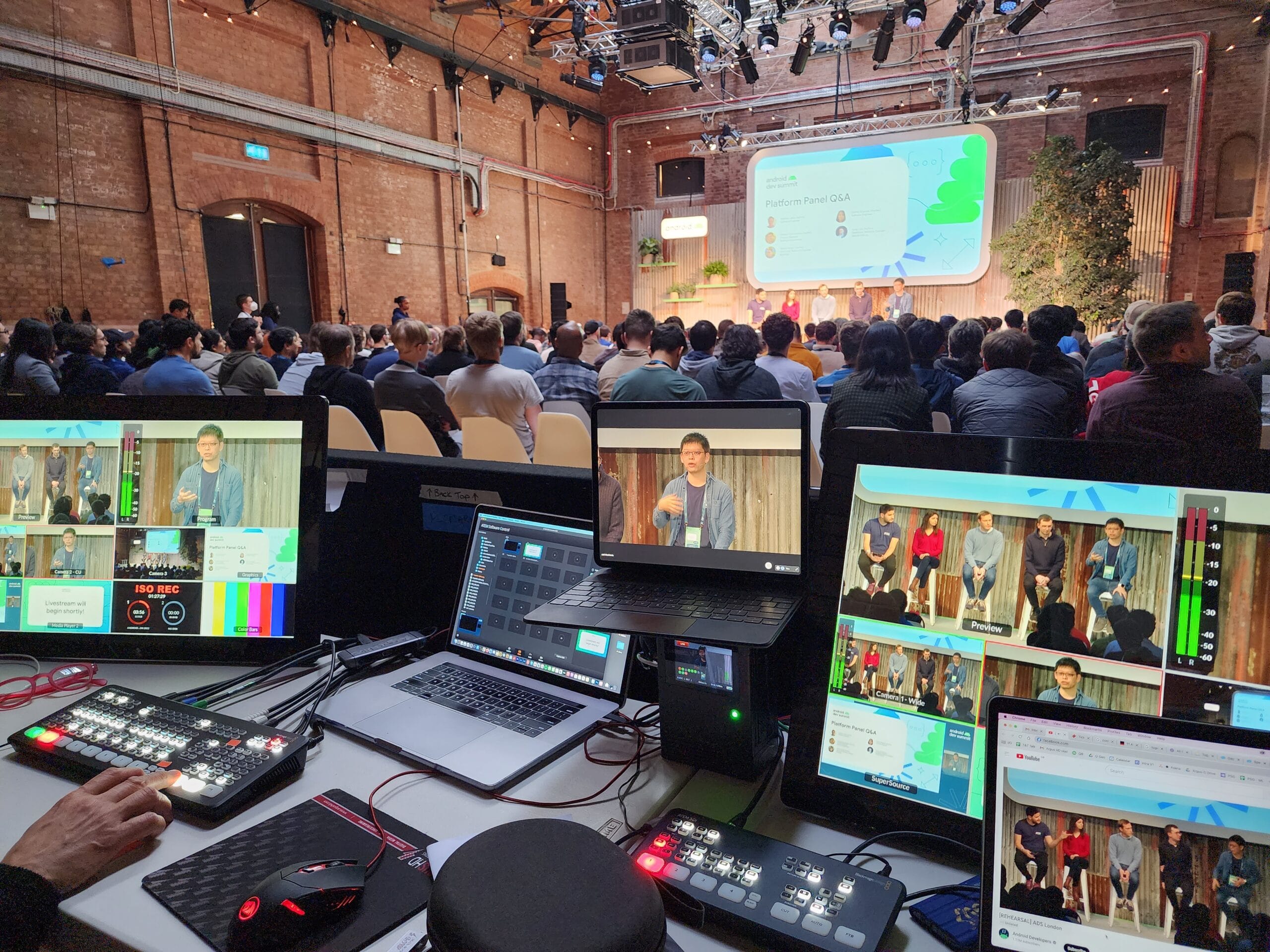
When we worked on the Android Dev Summit at the Computer History Museum in Mountain View, the production required full multi-camera capture, live broadcast engineering, simultaneous streaming infrastructure, and post-production delivery on a tight timeline. That was not an in-house job. That was a full-service AV and video production operation that required a team built specifically for that scale.
Where In-House Teams Win
This is not an argument that outside production companies are always the right answer. In-house teams have real advantages for specific types of work.
Content That Benefits From an In-House Team
- Weekly or daily social content, behind the scenes footage, and internal communications that need to move fast and do not require cinematic production value
- Executive talking head videos, internal town hall recordings, and training content where familiarity with the people and the subject matter matters more than technical polish
- Same-day or next-day turnaround on reactive content where there is no time to brief an outside team and schedule a crew
- High volume, low complexity output where the math of per-project pricing would exceed the cost of a dedicated hire
The honest version of this: if your organization produces two or more simple videos every week, an in-house hire likely makes financial sense. If you produce two or three high-stakes videos per quarter, it probably does not.
The Hybrid Model Is What Most Organizations Actually End Up With
The companies that handle this well do not choose one model and stick to it permanently. They split the work by what each model is actually good at.
An in-house team, even a single generalist hire, handles the content that needs to move fast and does not require a full crew: social clips, internal updates, quick interviews, training recordings, event recaps shot on a single camera. A production partner handles the work where the stakes are high enough that a mediocre result costs something real.
A product launch that is going to run as a paid campaign. An all-hands event for 1,000 employees that is also being livestreamed to a global audience. A customer story film that is going on the homepage. An earnings call broadcast. These are the moments where the quality of the production directly affects the credibility of the organization, and where professional event video production is not a luxury but a requirement.
How to Split the Work in Practice
- In-house: social content, internal comms, training videos, quick interviews, event documentation
- Production partner: keynotes and multi-session conference coverage, product launches, brand films, customer stories, livestreamed events, and anything where the audience extends beyond your own employees
- Post-production partner: highlight reels, sizzle cuts, and recap videos from events your in-house team documented but does not have the editing depth to finish at a professional level
What to Actually Look for in a Production Company
If your evaluation points toward hiring outside production support, the quality of the partner matters as much as the decision itself. A few things separate a production company that will make your job easier from one that will complicate it.
Portfolio That Matches Your Actual Needs
A reel of polished brand films does not tell you whether a company can manage a 10-camera live event. Ask for specific examples at the scale and format you need. Ask what their crew size was, what the technical scope was, and what problems they had to solve on site.
A Defined Production Process
How do they handle pre-production? What does the briefing process look like? Who is your point of contact on the day of the event? What happens if something goes wrong during a live show? A company that can answer all of these clearly has a process. A company that gives vague answers does not.
Transparent Pricing With a Written Scope
Flat rate quotes with no line items expand when scope changes. Ask for an itemized quote that breaks down crew, equipment, shoot days, post-production deliverables, and revision rounds. You should know exactly what you are paying for before anything is signed.
Redundancy Built Into Critical Moments
For any live or broadcast production, ask about backup systems. Backup cameras, backup audio, backup internet for the stream. A professional production company builds redundancy into every critical path. This is something we treat as non-negotiable at Argus HD. Our livestream and broadcast setups include bonded cellular failover and hardware encoder redundancy on every event where the stream going down would be a real problem.
Capability Beyond the Shoot Day
The best production partners are useful before and after the camera runs. Pre-production planning, run-of-show development, technical site surveys, and post-production delivery that matches your actual distribution needs. If you need a full event documented and then cut into a highlight reel for social, a recap video for the website, and a chapter-by-chapter breakdown for on-demand viewing, that is a different scope than just the shoot. Ask what the full workflow looks like, not just what happens on the day. Our guide on how event highlight videos increase brand visibility and ROI covers why the post-production strategy matters as much as the shoot itself.
Frequently Asked Questions
Can a small in-house team handle a large corporate event?
For documentation purposes, yes. For broadcast-quality multi-camera production with a simultaneous livestream, no. A one or two person in-house team can cover an event from a single camera angle and capture basic audio. Anything beyond that requires a dedicated crew with specialized roles.
What is the minimum event scale that justifies hiring a production company?
It is less about headcount and more about stakes. Any event where the content will be distributed publicly, used in a campaign, or viewed by people outside your organization justifies professional production. Any event where a technical failure cannot be recovered from in real time requires a crew with redundancy built in.
Does Argus HD offer retainer arrangements for ongoing production support?
Yes. For clients who need consistent production support across multiple events or a regular content calendar, we offer retainer arrangements that give you predictable access to a crew without negotiating a new scope every time. Contact us to discuss what that looks like for your specific production needs.
How does Argus HD work alongside an existing in-house team?
We work alongside in-house teams regularly. The typical arrangement is that the internal team handles day-to-day content while we come in for events, campaigns, or productions that exceed the internal team’s scale or technical capability. We have produced hotel AV and event productions where an internal team handled pre-event content and we managed the live event and post-production delivery.
What markets does Argus HD serve?
Argus HD is headquartered in South San Francisco and operates across the Bay Area, Los Angeles, New York, and nationally with trusted local crews. We have produced events from Mountain View to Manhattan. You can see our virtual and hybrid event production capabilities for clients who need consistent standards across multiple cities and time zones.